- ArtofACOdyssey 10: Heroes Armor Set
- ArtofACOdyssey 9: Signed Monuments
- ArtofACOdyssey 8: Lion of Keos
- ArtofACOdyssey 7: The Great Bronze Athena
- ArtofACOdyssey 6: Delphi
- ArtofACOdyssey 5: Typhoeus
- ArtofACOdyssey 4: Great Tumulus at Vergina
- ArtofACOdyssey: Potter
- ArtofACOdyssey 3: Parthenon Marbles
- ArtofACOdyssey 2: Architectural Decoration in Megara
- ArtofACOdyssey 1: Temple of Zeus at Sami
The Lore Tab
-
ArtofACOdyssey 10: Heroes Armor Set
Kassandra took some time out of her busy schedule to pose with her newly completed set of Greek Heroes armor! Let’s take a look at the pieces in #ArtofACOdyssey

Kassandra with a wolf friend, wearing the Greek Heroes armor set. Screenshot from Assassin’s Creed: Odyssey (Ubisoft 2018). First up, we have Perseus’ helmet. The artistic sources don’t agree on its precise form, although it often had wings (which are replicated here, on Kassandra’s temples) and conveyed invisibility. The flavor text alludes to both this and Perseus’ harpe. Pseudo-Hyginus (Astronomica 2.13) notes that the Greeks called it the Helmet of Hades and that Mercury gave it to Perseus along with talaria and a petasos, but notes that it wasn’t ACTUALLY the helmet of Hades because that would be stupid. Hesiod, on the other hand, says it was the cap of Hades and that it had the gloom of night about it (Shield of Heracles 216ff). There also seem to have been competing versions where Perseus got the gear from Hermes, or from Nymphs (Gantz 305).
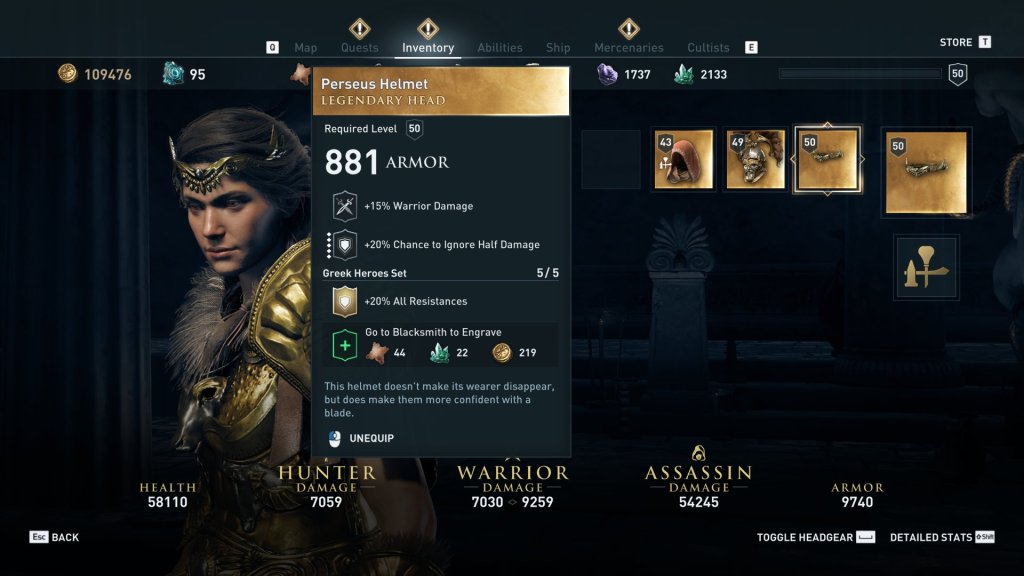
Next is none other than Jason’s Golden Fleece. Phrixus and Helle fled their stepmother on the back of a flying golden ram (sired by Poseidon), although Helle fell to her death in what is now the Hellespont. Once they reached Colchis (Georgia) he sacrificed the ram to Poseidon and married into the Colchian royal house. The fleece itself is shown as the hide of a ram, often hanging from a tree while Jason attempt to retrieve it. The kylix by Douris, which we discussed in the very first #ArtofACOdyssey post, is a notable example. At any rate, depictions of Jason and the fleece exist from as early as the 7th/8th c. BCE. While the fleece has been transformed into a cuirass, ram motifs are applied liberally. The flavor text here refers to Jason’s quest for the fleece in order to reclaim his throne.
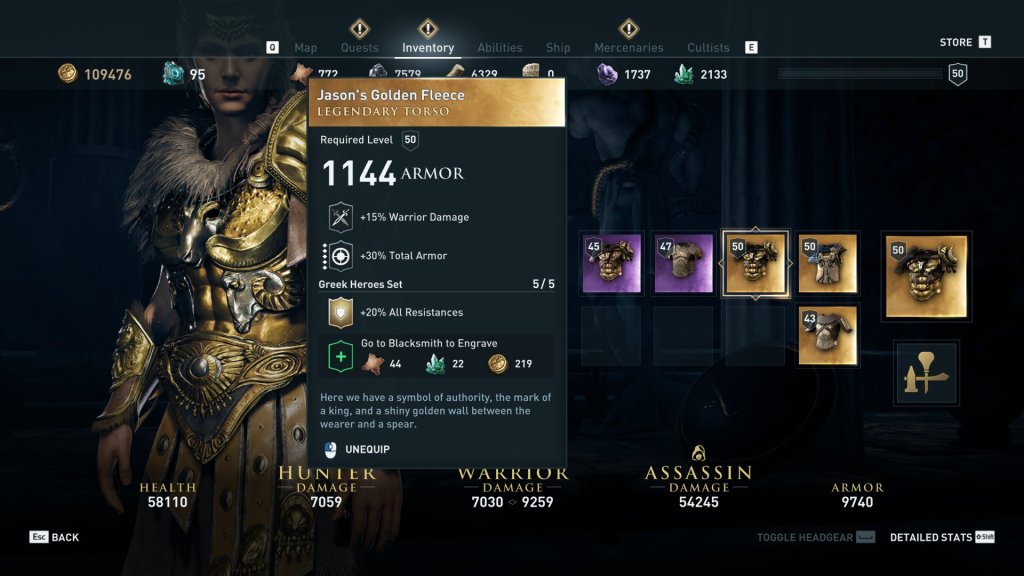
Third are the Bracers of Theseus. During the quest line on Crete you find an entire set of Theseus’ armor, although they are less powerful. As far as I am aware they aren’t particularly important in the mythological tradition – there are a sword and sandals (Kallimachos 235-6PF) which Aegeus leaves under a rock as tokens of recognition for his possible son to bring to Athens. The right bracer has an embossed scene of Theseus wrestling the Minotaur (perhaps he had these made after, when he was a rich king of Athens?).
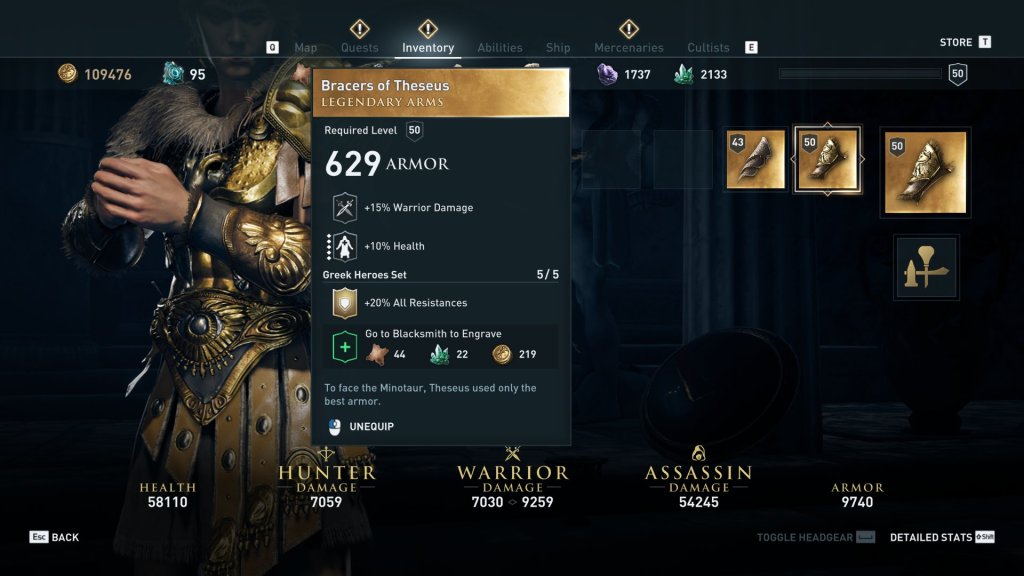
Fourth, we have the legendary Amazon queen Hippolyta’s belt, which Heracles was tasked with stealing as his 9th labor. Gantz (398) suggests that the belt was at first just proof of Heracles’ conquest of the Amazons, but later becomes the object of his quest. Apollonios is the first to name Hippolyta as the belt’s owner (AR 2.966-9). Apollodoros gives us the best known account, in which Hippolyta agrees to give Heracles the belt but Hera stirs up the Amazons with rumors, leading to a battle and Hippolyta’s death (ApB 2.5.9).

Finally, we have Atalanta’s Sandals. You get these after killing a mercenary named [Pheme] the Flash – apparently the given name is random. The mercenary prays for quickness and gets these shoes in return…although I think they look better on Kassandra. Atalanta, of course, was one of many badass women in Greek mythology. There are lots of different stories associated with a woman named Atalanta, although it isn’t clear if it is the same woman in each. The one referred to here refused to marry unless a suitor could beat her in a footrace, which of course no one could because of her legendary legs (see what I did there? Thanks for the obvious pun, Ubisoft). Hippomenes slows her down with super shiny magical apples from Aphrodite, enabling him to win the race and claim her hand…then, in the best Greek tradition, they die and/or get turned into lions. (Hes. frr 72-76 MW, elaborations by Ovid in Met 10.564-66). “Atalanta” is also mentioned as being part of the Argonauts (or wanting to), growing up with bears, and hunting the Kalydonian boar.
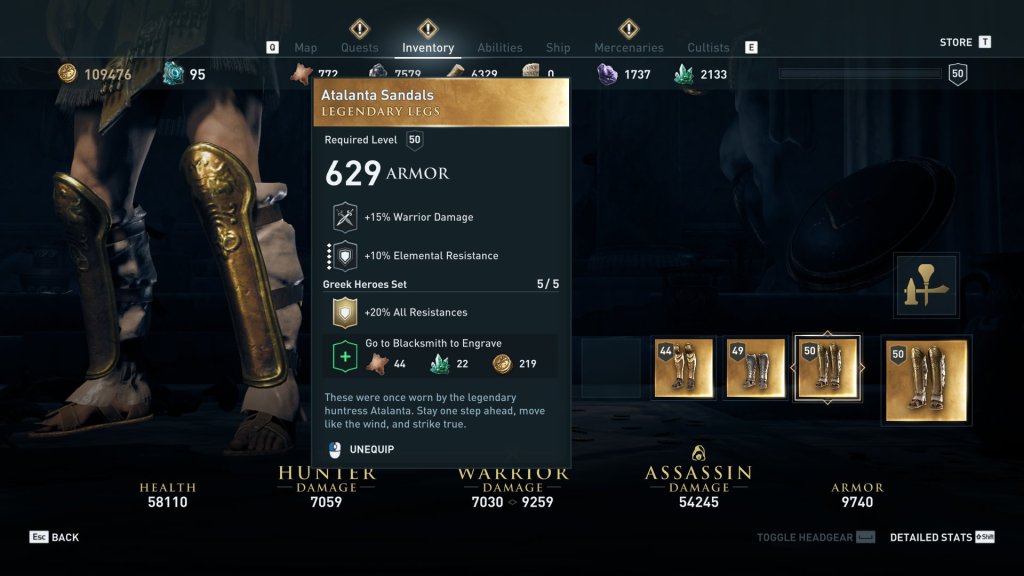
I especially appreciate the curated perks that go into this armor set, and how they relate to the heroes; Perseus avoiding damage (invisibility), Hippolyta’s melee resistance, and the set bonus of increased resistance across the board. What I love most, however, is that they provide yet another link between Kassandra/the player and classical mythology. For me at least, the ability to wear physical reminders of the heroes whose footsteps I am adventuring in is even more thrilling than the combat perks.
- All textual references taken from “Early Greek Myth” by Timothy Gantz.
- This was originally published on Twitter, November 11 2018.
-
ArtofACOdyssey 9: Signed Monuments
I’ve got something a little different today for #ArtofACOdyssey. I spent some time climbing around the Parthenon (as one does) to check out the ionic frieze and found something SUPER interesting on the inside of the porch.
Turns out, the Assassin’s Creed: Odyssey Parthenon has a bunch of anachronistic names inscribed! Pictured here are Ubisoft/Ubisoft Quebec technical art director Yannick Morel, 3D artists Hugo Lamarre and Mikael Boulet, and others that google isn’t letting me track down.
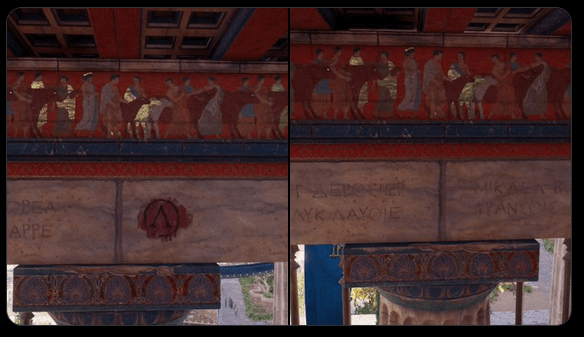
Ionic porch graffiti, Assassin’s Creed: Odyssey (Ubisoft 2018). While we take artist signatures for granted these days, most works in ancient Greece and Rome weren’t signed. There are some obvious exceptions of course…the Orestes and Elektra group from Palazzo Altemps is signed by Menelaos, student of Stephanos (who signed his own version, currently in Naples), and numerous ceramic vessels signed by potters and/or painters. When buildings are inscribed, they most often reflect who paid for them rather than who designed them.
Here’s looking at you, Pantheon…granted, the one we have was restored by Hadrian, who kept M. Agrippa’s name on the inscription in deference to the original. Most of the artists and architects we DO know about come from Pliny, Pausanias, and other authors who recorded them.
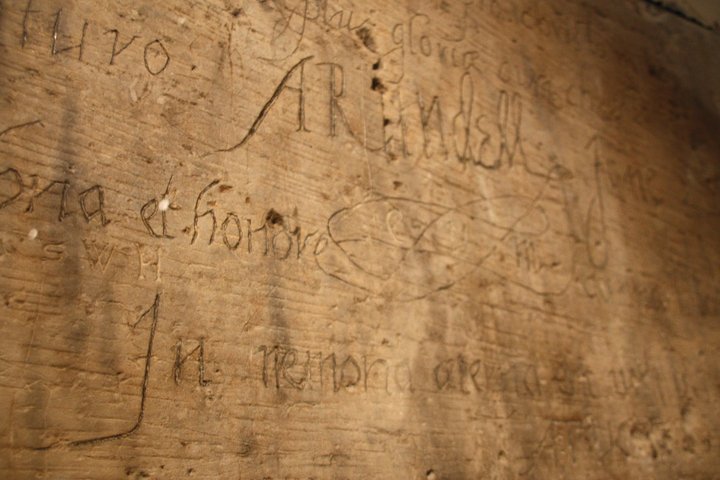
Prisoner graffiti, Beauchamp Tower, Tower of London. Photo: K. Jones. There is also a long running tradition of people inscribing their names on monuments – not only ones that they visited, but ones that they spent a lot of time in as well. Pictured here is prisoner graffiti from Beauchamp Tower in the Tower of London. but other examples include …the runic graffito in Hagia Sophia, Hubert Robert’s 1764 graffito on a fresco in the Villa Farnese at Caprarola. I highly recommend Charlotte Guichard’s article on artist graffiti in 18th c. Rome if you want to read up on it (Journal18, issue 1, Spring 2016).
More pertinent to us here are the reconstructions which incorporate some aspect of the modern artist and/or patron. A prime example of this is the base of Athena Parthenos in Nashville, where Pandora is flanked by divinities that look suspiciously like the project’s patrons. In short, AC Odyssey may deviate from the original Parthenon in this respect but it is also part of a long standing tradition. I would encourage you to climb up there yourself and check out the names of the folks who put so much work into this game.
- This was originally published on Twitter, October 24 2018.
-
ArtofACOdyssey 8: Lion of Keos
And we’re back with another installment of #ArtofACOdyssey! Today we’re exploring the Lion of Keos.

Lion of Keos, Assassin’s Creed Odyssey (Ubisoft 2018). If you’ve seen the actual Lion of Keos you probably think Assassin’s Creed: Odyssey has lost its mind. If you haven’t…here it is.

A very long, flat stone lion on the side of a hill. Photo via Wikimedia Commons, Phso2, CC-BY-SA 3.0/GNU. This is a great example of an archaic-style lion and is in pretty good condition, although it does look more like the Lion of Gripsholm Castle* than an actual lion.
*The Lion of Gripsholm Castle resulted from King Frederick I of Sweden’s need to have a stuffed lion in 1734. He sent the remains back to the royal taxidermist, who had evidently never seen a lion before, but did his best. The lion is now on facebook and on display in the castle.
Clearly neither of those are the lion we see in the game. What we are actually seeing is much closer to the 10m long Lion of Knidos. It was originally the crowning glory of a monumental tomb and is now on display at the British Museum.
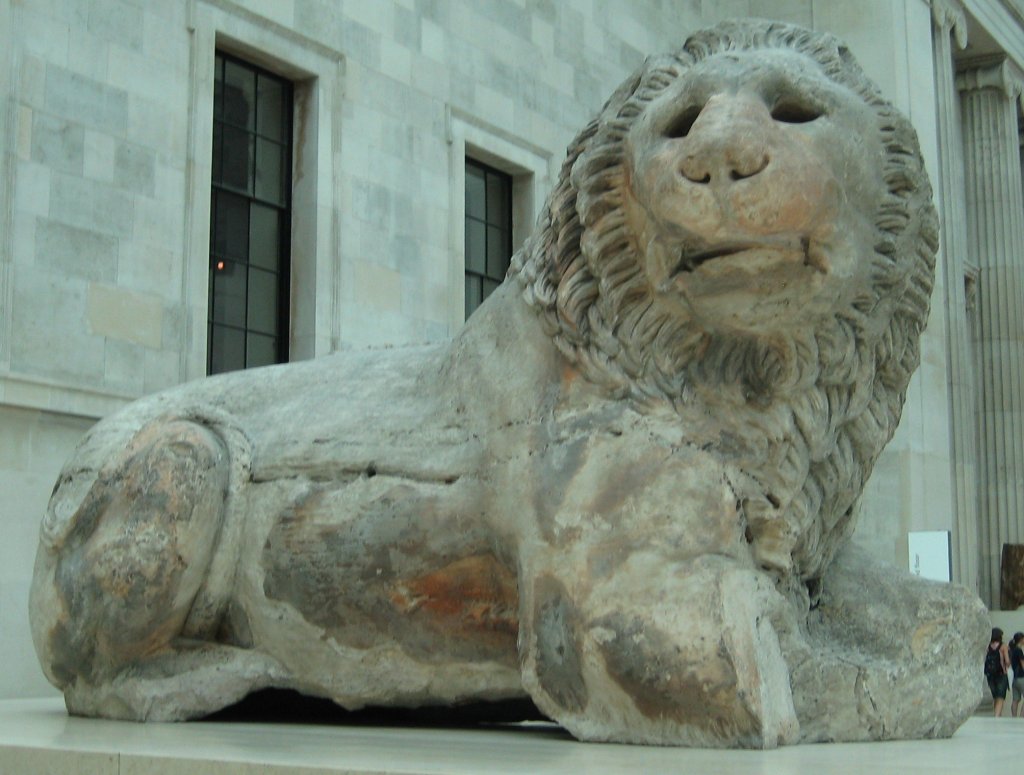
Lion of Knidos, 2nd c. BCE. British Museum. Photo: K. Jones. It isn’t an exact match – the position of the tail and articulation of the mane are different, among other things – but the Assassin’s Creed lion isn’t nearly stylized enough to be based on any archaic examples.
So why the change? The Lion of Keos is famous enough that is would be weird NOT to have it on the island, but the original doesn’t exactly fit the aesthetic of the game. If I had to guess, I’d say that’s why Ubisoft subbed it out for the Knidian version.
-
ArtofACOdyssey 7: The Great Bronze Athena
Rounding out our launch week extravaganza, we’re finishing strong on DAY 7 of #ArtofACOdyssey with the Great Bronze Athena.

Great Bronze Athena, Acropolis of Athens. Screenshot from Assassin’s Creed: Odyssey (Ubisoft 2018). 
Obviously, such a gigantic statue is not extant but we do know a few things for sure. Pausanias (1.28.2) tells us that you could see the tip of the spear and crest of the helmet when you rounded Sounion which, I am happy to confirm, you can also do in AC Odyssey.
It was made by Phidias, who also made the colossal chryselephantine statues of Zeus at Olympia and Athena Parthenos. The statue was referred to as Phidias’ Athena Promachos in the 4th c. CE and kept that name for a while – Athena ‘first to the fight.’
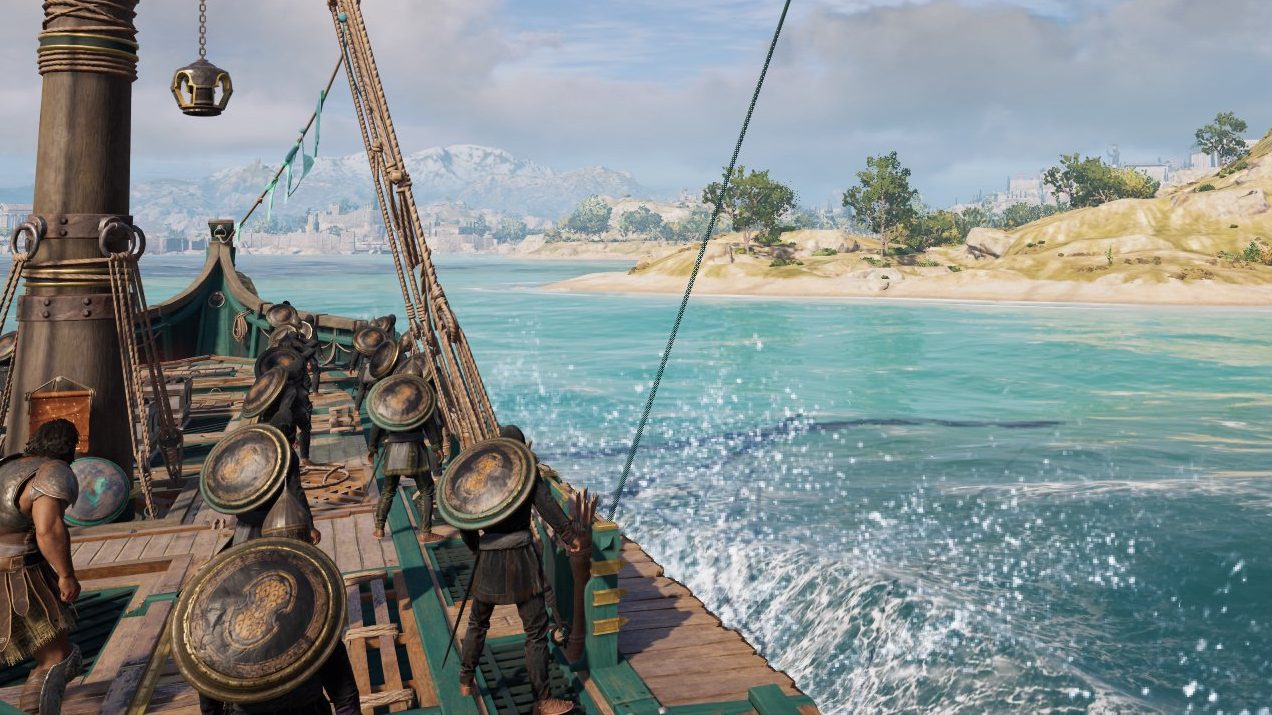
Approaching Athens from Sounion. Screenshot from Assassin’s Creed: Odyssey (Ubisoft 2018). “Promachos” is also applied to the genre of striding Athena representations with raised shield and spear. The misnomer influenced generations of scholarly thought on the Acropolis, as can be seen in Leo von Klenze’s painting of 1846. However, thanks to a series of 3rd c. CE coins minted in Attica that show the Acropolis, we know that she was standing stationary with an object in her outstretched right hand – likely an owl, but possibly a Nike figure. Some smaller bronze figures replicate the pose.
Obviously, the Assassin’s Creed Odyssey Athena is different. What they’ve done here is modeled the body for the Athena Parthenos and more or less copied it for the Great Athena, as you can see here. They changed the ivory and gold to bronze, switched the right arm and removed the snake, but the body, aegis, and helmet are the same. I think that the aegis would have been similar between the two but as for the helmet, the Parthenos is so specific it’s hard to say.
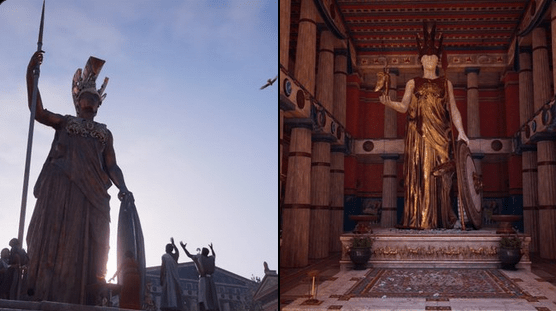

Comparisons between the Great Bronze Athena and the Athena Parthenos. Screenshots from Assassin’s Creed: Odyssey (Ubisoft 2018). While I can’t speak to the reasons for the change (I suspect it had something to do with deadlines), what I am most pleased about is that Ubisoft Quebec really got the monumentality right. When you’re approaching Athens or wandering the Acropolis, they have a presence.
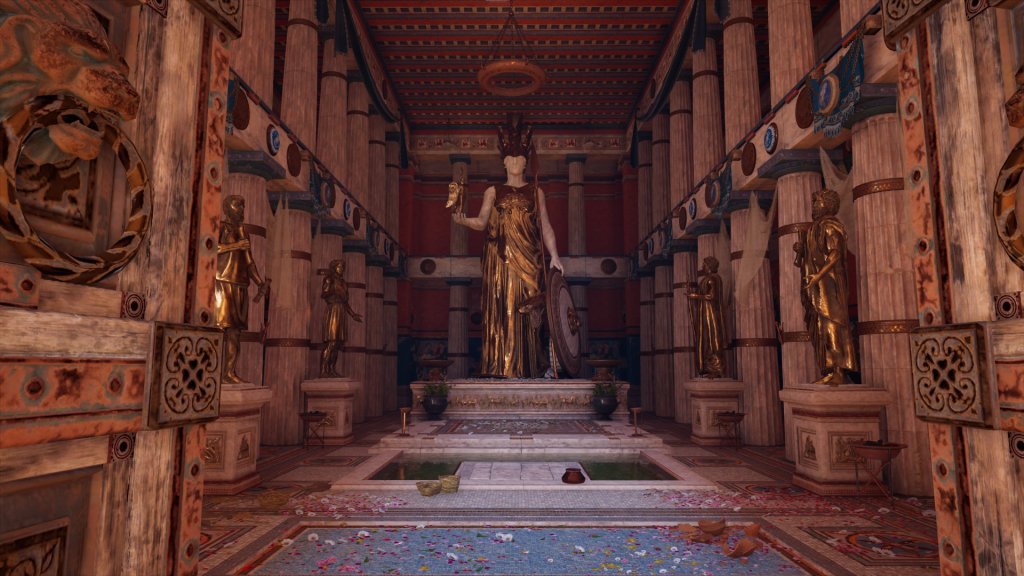
Interior of the Parthenon, Assassin’s Creed Odyssey (Ubisoft 2018). That presence is something I’ve never been able to communicate to my students properly, but I hope with Assassin’s Creed Odyssey my future classes will get some idea of the awe-inspiring, iconic quality they brought to ancient Athens. Then, of course, we’ll pick apart the iconography and have a good discussion on creative choices in classical reception works. 🙂
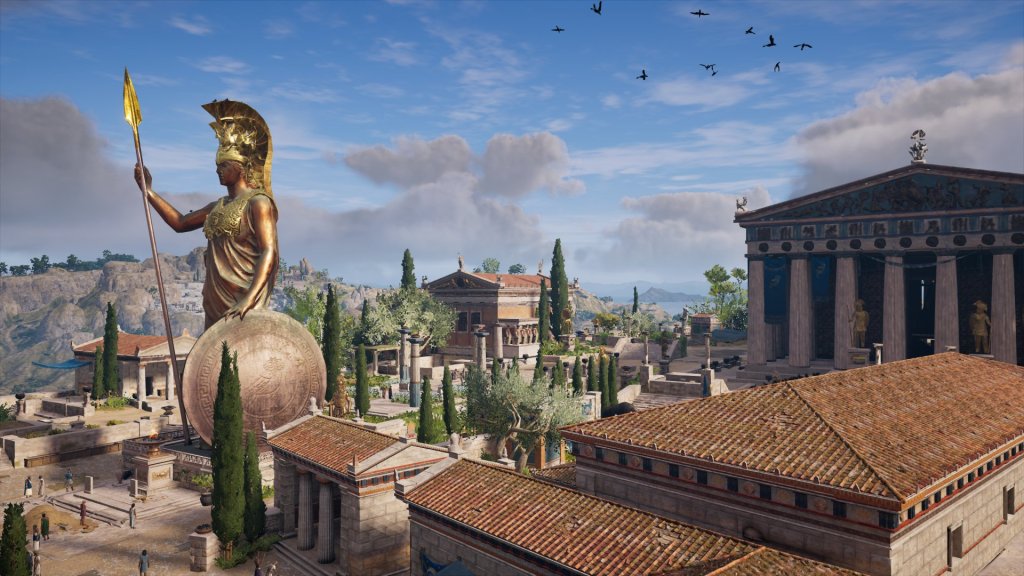
View of the Acropolis, Assassin’s Creed Odyssey (Ubisoft 2018). - This was originally posted on Twitter, October 14 2018.
-
ArtofACOdyssey 6: Delphi
It’s time for DAY 6 of #ArtofACOdyssey, brought to you by a very disappointed art historian who did not find the Bronze Athena in Piraeus. So, we’re going to my other happy place – Delphi!

Now, a word before we start. The layout of the sanctuary it pretty solid – rather than just climbing over anything in my way like I normally do, I made sure to walk AROUND the mountain and up the sacred way. It was stunning, and I fangirled. A lot. Unfortunately, while the geography is good the decorations aren’t as accurate. Since making it to Athens I’ve decided this was likely a result of Ubisoft rationing their time towards places where the majority of players are likely to hang out. We don’t spend much time in Delphi.
Well, most people don’t. I spent 30 minutes taking detail shots of Athena Pronaia. ANYWAYS. Back to today’s object. The first treasury you see is the Sikyonian Treasury, not labelled on the game map but right where it should be.
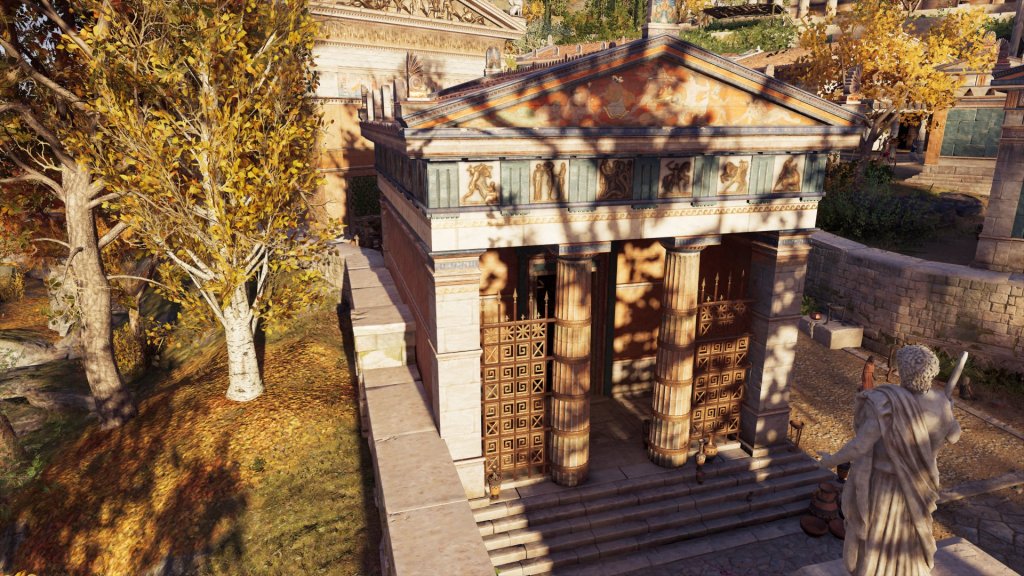
Sikyonian Treasury, Delphi. Screenshot from Assassin’s Creed: Odyssey (Ubisoft 2018). Since we know each treasury (and temple) had more or less bespoke decoration, and these metopes are pretty famous for not being on the Sikyonian Treasury, we can safely assume that they were put in the rubber stamp kit for temple decoration. You see them elsewhere as well. I do want to make clear that Ubisoft was working on a very short schedule to roll this game out (Origins dropped about a year ago and most of their team would have been working on that – it usually takes 3+ years for a sequel to come out) and what they have done is amazing.
So, no hard feelings for prioritizing. What that means is that like the Vergina motifs and Parthenon frieze bits, we get to see these everywhere. You probably at least recognized the main character here – what we have is Hercules’ canonical labors.
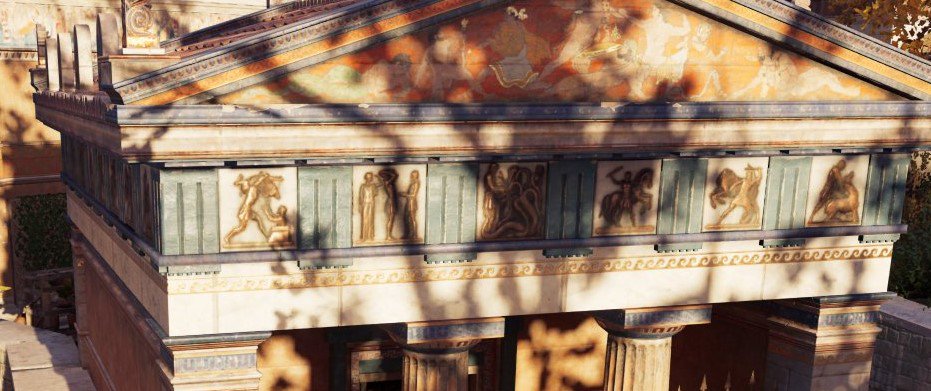
Screenshot from Assassin’s Creed: Odyssey (Ubisoft 2018). They aren’t in order, but they are a good likeness. Starting from left we have the Erymanthian boar, Atlas, the Hydra, the Man-Eating Horse(s) of Diomedes, the Cretan Bull, and the Ceryneian Hind (reversed). All of them were originally on the Temple of Zeus at Olympia/c. 460 BCE. Here’s the Cretan Bull metope, which you can see at the Louvre. The bull is the same one that caused havoc on Crete – i.e., Minotaur baby-daddy.
Notably, this temple was the first place where the labors were canonized. The Trojan ketos, Nessus, Monkey Cercopes, Caucasian Eagle, and others were relegated to the Parerga, or “lesser labors”. Kind of like the side quests we do in Odyssey. However, thanks to the Temple of Zeus at Olympia, the twelve labors chosen for the metopes were fused into the narrative we are familiar with today.
- This was originally posted on Twitter, October 12 2018.
-
ArtofACOdyssey 5: Typhoeus
It’s hard to believe we are already on DAY 5 of #ArtofACOdyssey. Today’s offering (see what I did there?) is a…well-loved vessel with a picture of one of the most recognizable Greek monsters.
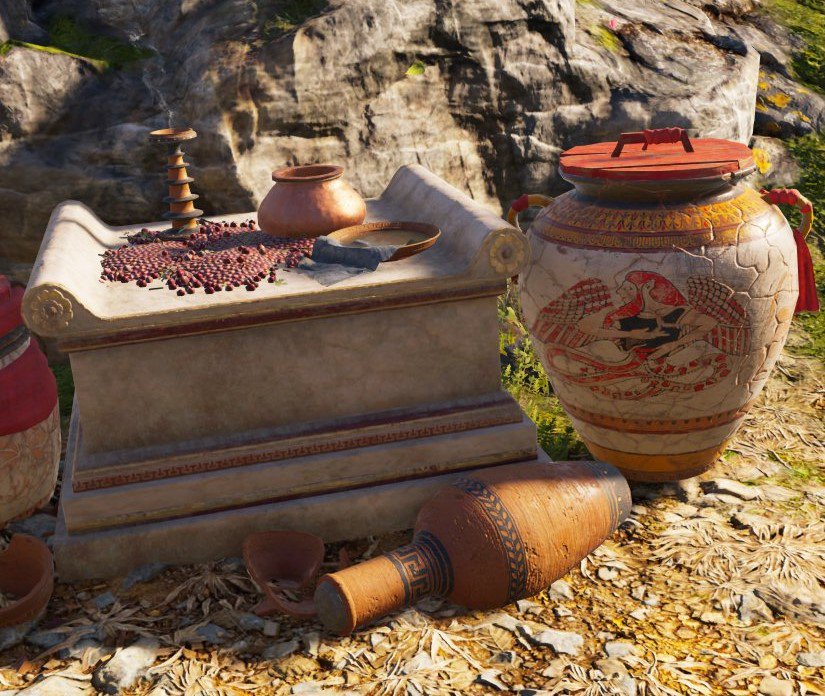
Altar with offerings and a Typhoeus vase. Screenshot from Assassin’s Creed: Odyssey (Ubisoft 2018). It’s also apparently a favorite of the dev team as you will find it EVERYWHERE. If you guessed Typhoeus (Typhon), you’re right! The original is on a Chalcidian black figure hydria currently in the Staatliche Antikensammlungen, c. 540 BCE.
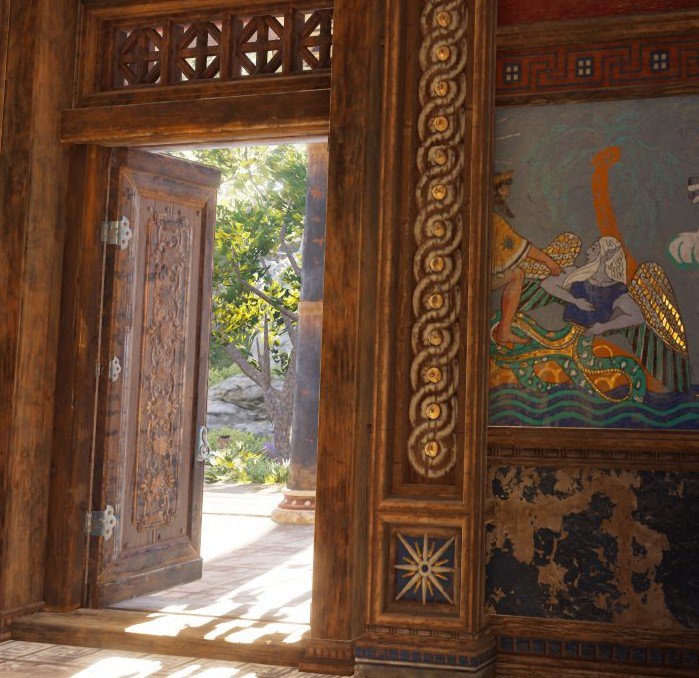
Typhoeus was the last and greatest child of Gaia and the last obstacle between the young Zeus and supremacy. He was chaos incarnate: Hesiod describes him as having a hundred dragon heads, eyes that shot fire, and a voice that included every inhuman sound (Theo. 820ff). Suffice to say it was a tough fight. Zeus finally took him down with his lightning bolt, but not before much of the earth was scorched and Typhoeus had sired numerous children with Echidna – hence their nicknames, the father and mother of monsters.
While Typhoeus gets his own space on this particular item, you can see a more faithful representation of the scene on the game map (assuming you haven’t explored everything – it’s a here-be-monsters placeholder) and on temples, such as the Temple of Zeus in Kefalonia from Day 1.
Typhoeus fresco in Megara. Screenshot from Assassin’s Creed: Odyssey (Ubisoft 2018). -
ArtofACOdyssey 4: Great Tumulus at Vergina
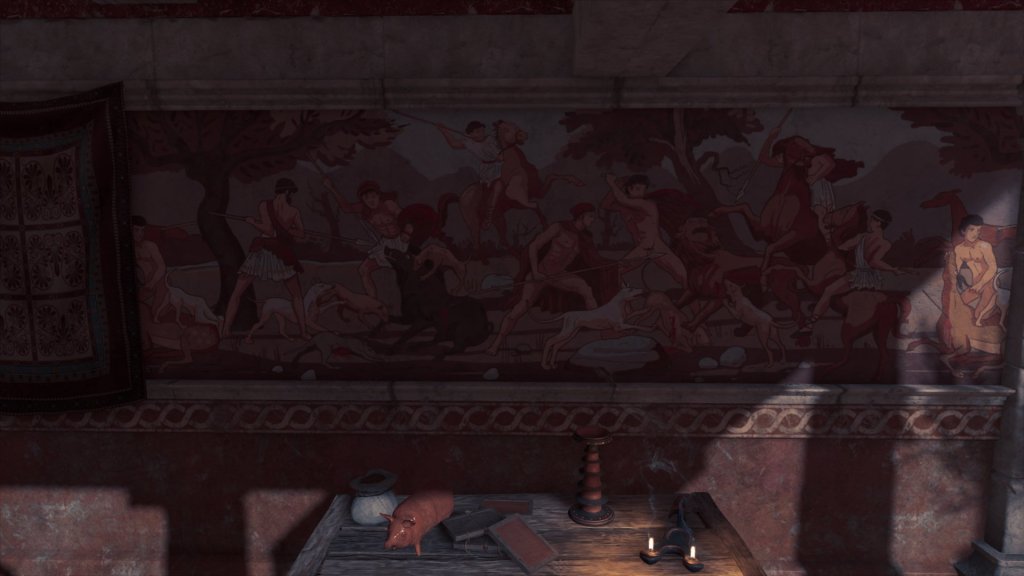
Hunt scene based on the Tomb of Philip fresco, Assassin’s Creed: Odyssey (Ubisoft 2018). And here we are with DAY 4 of #ArtofACOdyssey! Today’s showcase is rather anachronistic, but so fabulous I don’t blame Ubisoft for including it in Assassin’s Creed: Odyssey. Here it is in (I think) the temple of Athena at Megara.
Now, you might be tempted to identify it as one of the many Calydonian boar hunt vases/friezes but if you look closely you’ll also note a lion and a few deer. In a related note, you do get to fight the Calydonian boar in game but have to do it by yourself. I know Kassandra is part of “the bloodline” and all but even Meleager got to bring a party! I’m lodging an official complaint. At any rate, this particular hunt isn’t from a vase at all but rather the late 4th BCE facade (from the “Tomb of Philip”) of the Great Tumulus at Vergina.
By far the most impressive thing about the tomb is that it had not been looted – tomb III was intact as well, and while tomb I had been desecrated the famous Rape of Persephone fresco remained. Tomb II is referred to colloquially as the tomb of Philip II, Alexander’s father and ruler of Macedon. There has since been considerable debate about whether or not it was actually HIS tomb (Bartsiokas’ 2000 article aims to be decisive) but that’s beyond this thread.
The fresco in Athena’s temple is quite nearly faithful to the original but does repeat the figure sequence. It is also clearly based on the reproductions which, again, I don’t blame the devs for – I use them too when I teach about Vergina just for the sake of legibility. Like the Parthenon, this monument and its contents were also used repeatedly. Notice the golden boxes in this pile of offerings (screen shot at Tomb of the 1st Pythia)? That’s the 24 carat gold larnax which held the remains of Tomb II’s occupant.
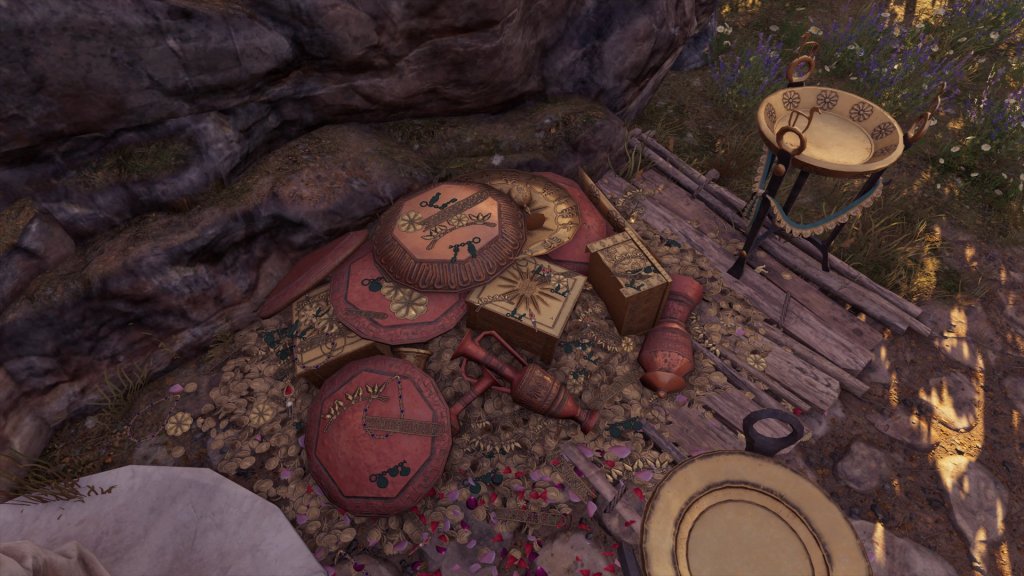
Pile of treasure in Assassin’s Creed: Odyssey (Ubisoft 2018). It has lower relief-work on the sides and the rosettes are part of the box rather than added separately, but otherwise the decorative scheme and distinctive “Vergina star” are identical. The larnax was the funerary vessel of choice in Minoan times and experienced a resurgence in the Hellenistic period. Most were terracotta but some, like this, were made of precious materials. If you’d like to learn more about the Vergina excavations, look up Manolis Andronikos.
I have to mention the adorable double-nozzle oil lamp in the first picture, with the beautiful black glaze. I haven’t found the original (YET) but if you’ve seen it, let us know!
- This was originally posted on Twitter, October 10 2018.
-
ArtofACOdyssey: Potter
Bonus #ArtofACOdyssey – this potter at Delphi, who will be having none of your questions and would thank you kindly to get out of his light.

Potter at Delphi. Screenshot from Assassin’s Creed: Odyssey (Ubosoft 2018). - This was originally posted on Twitter, October 9 2018.
-
ArtofACOdyssey 3: Parthenon Marbles
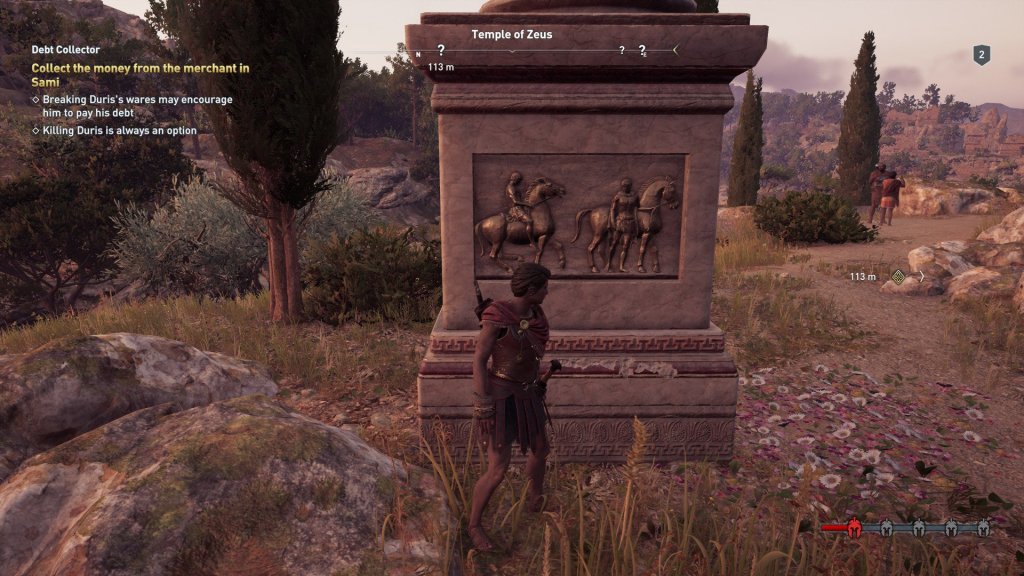
Statue base featuring a Parthenon frieze block. Screenshot from Assassin’s Creed: Odyssey (Ubisoft 2018). Day 3 of #ArtofACOdyssey! I’ll give you a second to think about where you’ve seen this before. Hint: it’s a huge tourist attraction in London that probably shouldn’t be there.
That’s right! It’s Block W-5 from the Parthenon Ionic Frieze! You may be wondering why I am so frightfully specific. That, dear reader, is because I am very familiar with this block. Very, painfully, familiar. Mostly because I worked around the clock for weeks making a 1:1 scale model out of rigid foam insulation, glue and cement compound, cheesecloth and specially mixed paint. Here’s a picture of my low-relief panels (5 in colour, half of 6 in white) juxtaposed with Rebecca Levitan’s 2-D panels on Nashville’s Parthenon.
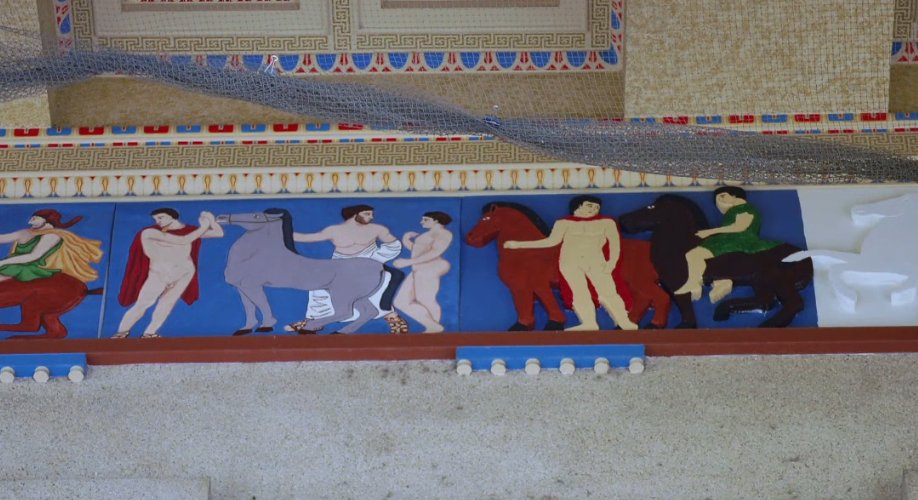
Painted 2D and 3D replicas of Parthenon frieze blocks, on the Nashville Parthenon. Photo: K. Jones. We (Emory Parthenon Project) were testing the visibility of the Ionic Frieze from various distances, and discerning what role colour and depth played in all that. TL;DR: you could totally see the frieze from a good distance away. None of that “built for the gods’ eyes alone” nonsense. But, back to our statue base. Like the Jason panel painting from day 1, this panel has been extended to better fit the space as well. The Parthenon sculptures appear to have been used quite heavily in Assassin’s Creed: Odyssey so keep an eye out as you play!
- This was originally published on Twitter, October 9 2018.
-
ArtofACOdyssey 2: Architectural Decoration in Megara
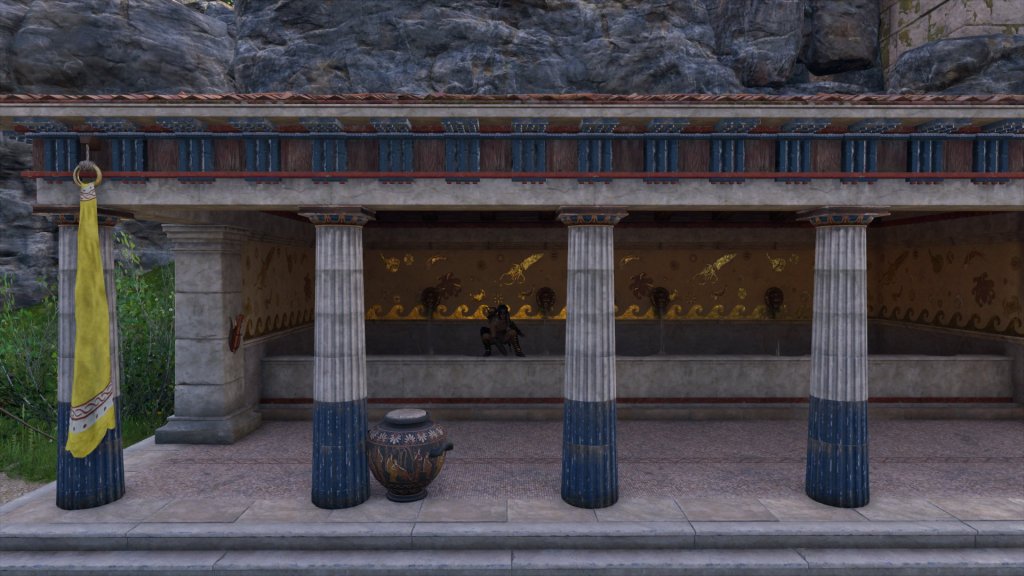
Fountain in Megara. Screenshot from Assassin’s Creed: Odyssey (Ubisoft 2018). Are you all ready for Day 2 of #ArtofACOdyssey? Today I finally made it off of Kefalonia and sailed my fancy new ship to the mainland where I found these lion head waterspouts in Megara. This particular fountain arrangement was probably inspired by scenes like the one on this hydria in the MET. Lion heads weren’t just for fountains either. As you can see in the reconstruction drawing of the Stoa at the Sanctuary of the Great Gods on Samothrace, they could also aid in roof drainage.
You probably noticed the lovely gilded marine life as well. These don’t appear to have come from any one source, but the octopus and striped fish in the upper left are very similar to those on an Apulean fish plate (workshop of Asteas/Python, c. 340-330 BCE) in the Toledo Museum.

Rear wall of a fountain house in Megara. Screenshot from Assassin’s Creed Odyssey (Ubisoft 2018). - Originally posted on Twitter, October 8 2018.


